Amazing & Complete Note Names Guide You Will Love
Note names are the labels musicians use to name every pitch, from the seven natural letters A through G to sharps, flats, and solfege syllables like Do, Re, and Mi. These names appear on piano keys, guitar frets, and sheet music staves so players can read and play songs quickly.
Learning note names looks hard, but the whole system repeats in one simple pattern. In this article, we will discuss about note names.
Quick Picks
Short on time? Start with these six standouts.
- Middle C The home note for piano beginners.
- Do The easiest singing name for C.
- Whole Note Four beats in one symbol.
- FACE Treble spaces spell a word.
- Low E String Thickest guitar string.
- C#4 First sharp every pianist learns.
Piano note names and staff note names follow different rules, so learn both.
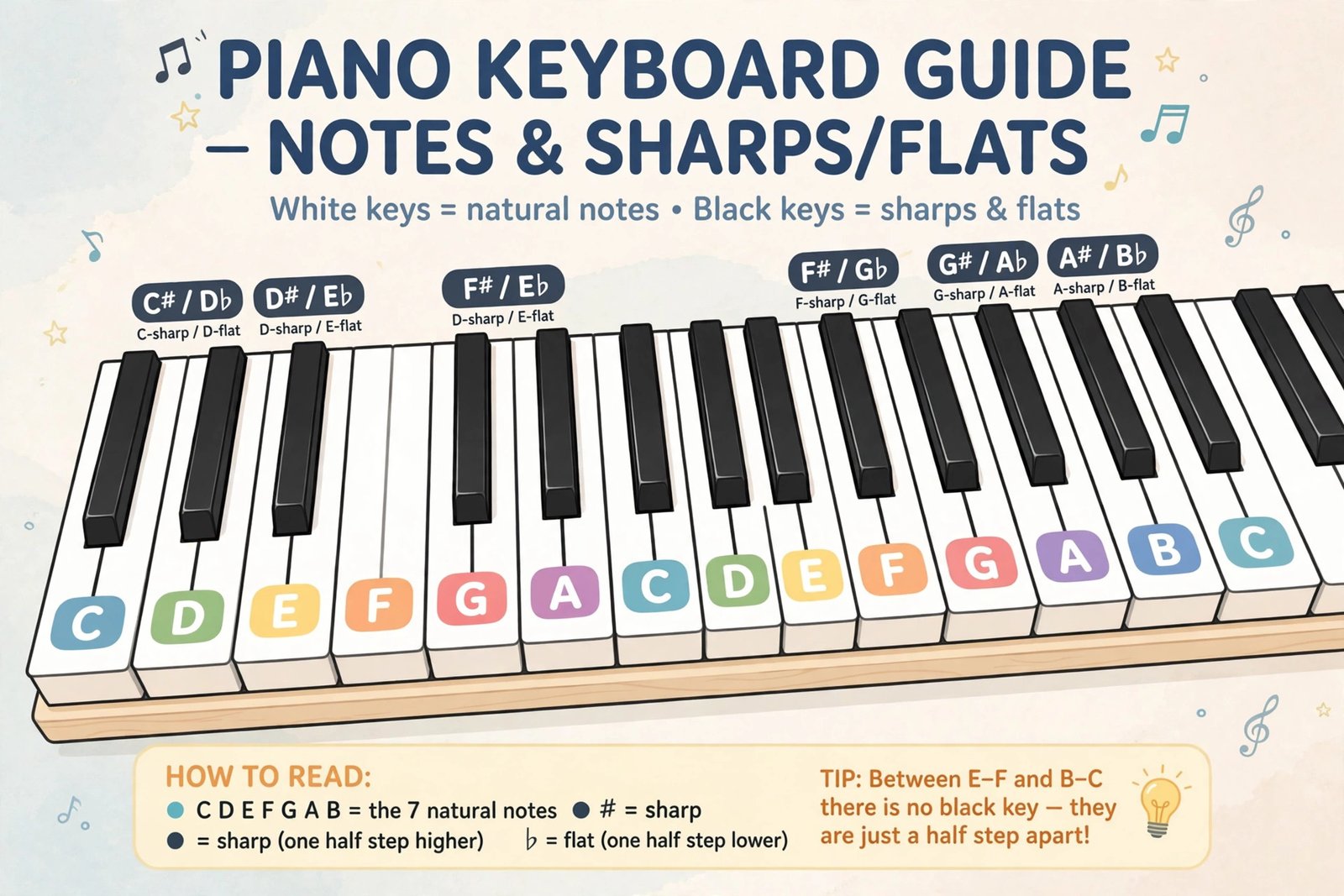
- Piano note names Repeat the same A to G pattern on every octave of keys.
- Staff note names Change with the clef, so treble and bass use different letters.
What Are the Seven Basic Notes?
The basic note names are the seven letters A through G, repeated across every octave.
- C Starting point of scales
- D Note right after C
- E Note right after D
- F Note right after E
- G Note right after F
- A Note right after G
- B Last alphabet music letter
- Middle C Piano center reference note
- C4 Middle C science name
- A4 Standard tuning pitch note
- Octave Eight note repeating span
- C3 Low middle piano note
- C5 C one octave higher
- C2 Deep bass piano note
- C6 Very high piano note
- G4 Treble curl marks G
- F3 Bass dots mark F
- E4 Bottom treble staff line
- G2 Bottom bass staff line
- D4 Space below treble staff
- B3 Space above bass staff
- A0 Lowest piano key
- C8 Highest piano key
- Natural Plain note no alteration
- Chromatic All twelve pitch names
Which Notes Are Called Sharps?
Sharp note names raise a natural note by a half step, like C sharp from C.
- C#0 Lowest sharp piano note
- C#1 Low C sharp octave
- C#2 Deep C sharp note
- C#3 Middle area C sharp
- C#4 Bright C sharp note
- D#0 Lowest D sharp note
- D#1 Low D sharp octave
- D#2 Deep D sharp note
- D#3 Middle area D sharp
- D#4 Bright D sharp note
- F#0 Lowest F sharp note
- F#1 Low F sharp octave
- F#2 Deep F sharp note
- F#3 Middle area F sharp
- F#4 Bright F sharp note
- G#0 Lowest G sharp note
- G#1 Low G sharp octave
- G#2 Deep G sharp note
- G#3 Middle area G sharp
- G#4 Bright G sharp note
- A#0 Lowest A sharp note
- A#1 Low A sharp octave
- A#2 Deep A sharp note
- A#3 Middle area A sharp
- A#4 Bright A sharp note
Which Notes Are Called Flats?
Flat note names lower a natural note by a half step, like D flat from D.
- Db0 Lowest flat piano note
- Db1 Low D flat octave
- Db2 Deep D flat note
- Db3 Middle area D flat
- Db4 Bright D flat note
- Eb0 Lowest E flat note
- Eb1 Low E flat octave
- Eb2 Deep E flat note
- Eb3 Middle area E flat
- Eb4 Bright E flat note
- Gb0 Lowest G flat note
- Gb1 Low G flat octave
- Gb2 Deep G flat note
- Gb3 Middle area G flat
- Gb4 Bright G flat note
- Ab0 Lowest A flat note
- Ab1 Low A flat octave
- Ab2 Deep A flat note
- Ab3 Middle area A flat
- Ab4 Bright A flat note
- Bb0 Lowest B flat note
- Bb1 Low B flat octave
- Bb2 Deep B flat note
- Bb3 Middle area B flat
- Bb4 Bright B flat note
What Are Solfege Syllables?
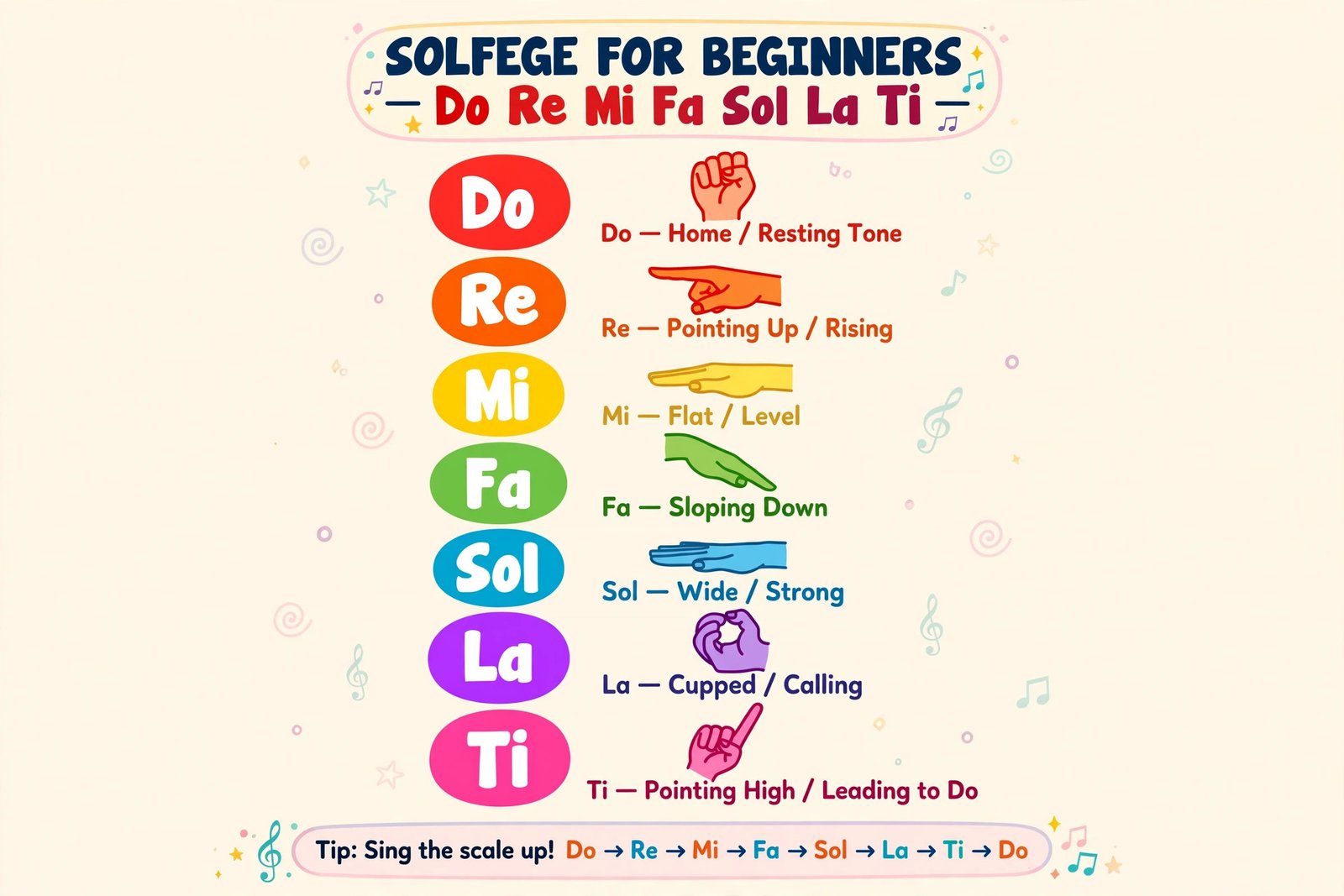
Solfege note names are singing syllables that name each step of a scale.
- Do First singing scale syllable
- Re Second singing scale syllable
- Mi Third singing scale syllable
- Fa Fourth singing scale syllable
- Sol Fifth singing scale syllable
- La Sixth singing scale syllable
- Ti Seventh singing scale syllable
- Sargam Sa First Indian scale syllable
- Sargam Re Second Indian scale syllable
- Sargam Ga Third Indian scale syllable
- Sargam Ma Fourth Indian scale syllable
- Sargam Pa Fifth Indian scale syllable
- Sargam Dha Sixth Indian scale syllable
- Sargam Ni Seventh Indian scale syllable
- Movable Do Do follows key center
- Fixed Do Do always means C
- Tonic Solfa Singing method using syllables
- High Do Do one octave higher
- Low Do Do one octave lower
- Hand Do Closed fist hand sign
- Hand Re Slanted palm hand sign
- Hand Mi Flat palm hand sign
- Hand Fa Thumb down hand sign
- Hand Sol Open palm hand sign
- Kodály Hand sign teaching method
What Are Note Lengths Called?
Note value names tell you how long each note lasts in a measure.
- Whole Note Four beat long note
- Half Note Two beat long note
- Quarter Note One beat long note
- Eighth Note Half beat quick note
- Sixteenth Note Quarter beat fast note
- Thirty Second Note Very fast tiny note
- Sixty Fourth Note Extremely fast tiny note
- Breve Double whole long note
- Semibreve British whole note name
- Minim British half note name
- Crotchet British quarter note name
- Quaver British eighth note name
- Semiquaver British sixteenth note name
- Demisemiquaver British thirty second name
- Dotted Half Half note plus quarter
- Dotted Quarter Quarter note plus eighth
- Dotted Eighth Eighth plus sixteenth note
- Whole Rest Four beat long silence
- Half Rest Two beat long silence
- Quarter Rest One beat long silence
- Eighth Rest Half beat short silence
- Sixteenth Rest Quarter beat short silence
- Tie Connects two same notes
- Beam Joins fast note stems
- Flag Small mark on stem
Which Notes Live in Treble Clef?
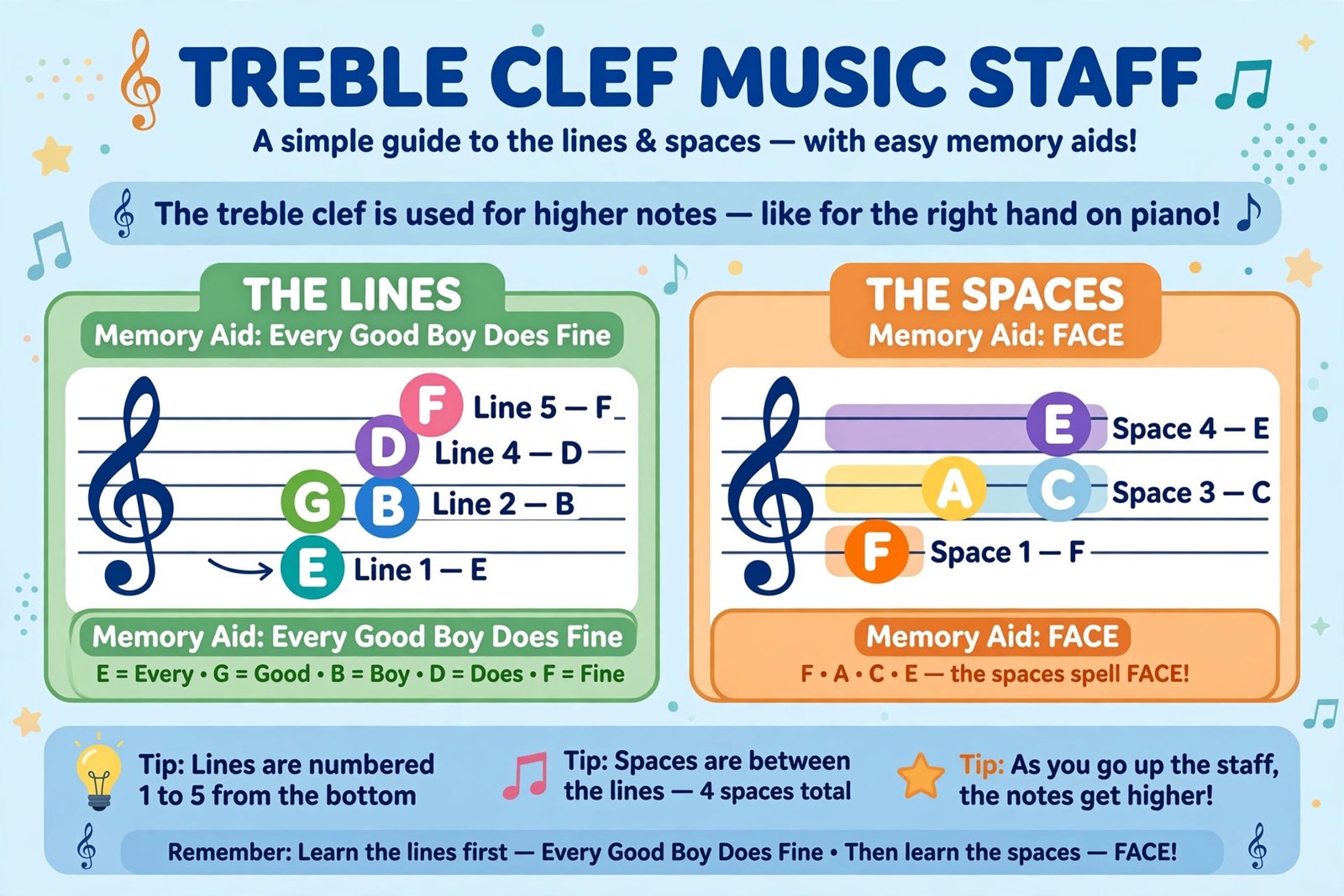
Treble clef note names come from the five lines and four spaces of the upper staff.
- Bottom Line Bottom treble staff line
- Second Line Treble G anchor line
- Middle Line Treble center B line
- Fourth Line Treble upper D line
- Top Line Top treble F line
- First Space Lowest treble F space
- Second Space Treble A second space
- Third Space Treble C third space
- Top Space Highest treble E space
- Below Staff D Space below treble staff
- Middle C Ledger C ledger below staff
- Low B Space below middle C
- Low A Ledger line below C
- Low G Space below low A
- Above G Space above treble staff
- High A Line above treble staff
- High B Space above high A
- High C Ledger C ledger above staff
- High D Space above high C
- High E Line above high D
- Line Phrase Remembers treble line notes
- Space Word Remembers treble space notes
- G Curl Curl shows G line
- Landmark G Reference for nearby notes
- Grand Staff Both staffs joined together
Which Notes Live in Bass Clef?
Bass clef note names cover the lower staff where the piano left hand plays.
- Bass Bottom Line Bottom bass staff line
- Bass Second Line Bass B second line
- Bass Middle Line Bass center D line
- Bass Fourth Line Bass upper F line
- Bass Top Line Top bass A line
- Bass First Space Lowest bass A space
- Bass Second Space Bass C second space
- Bass Third Space Bass E third space
- Bass Top Space Highest bass G space
- Above Staff C Ledger above bass staff
- Above Bass D Space above middle C
- Above Bass E Line above bass staff
- Above Bass F Space above E line
- Below Bass F Space below bass staff
- Below Bass E Ledger below bass staff
- Below Bass D Space below E ledger
- Below Bass C Second ledger below staff
- Below Bass B Space below C ledger
- Bass Line Phrase Remembers bass line notes
- Bass Space Phrase Remembers bass space notes
- F Dots Dots show F line
- Bass Landmark F Reference for nearby notes
- C Clef Marks middle C line
- Alto Clef C on middle line
- Tenor Clef C on fourth line
What Notes Do Piano and Guitar Use?
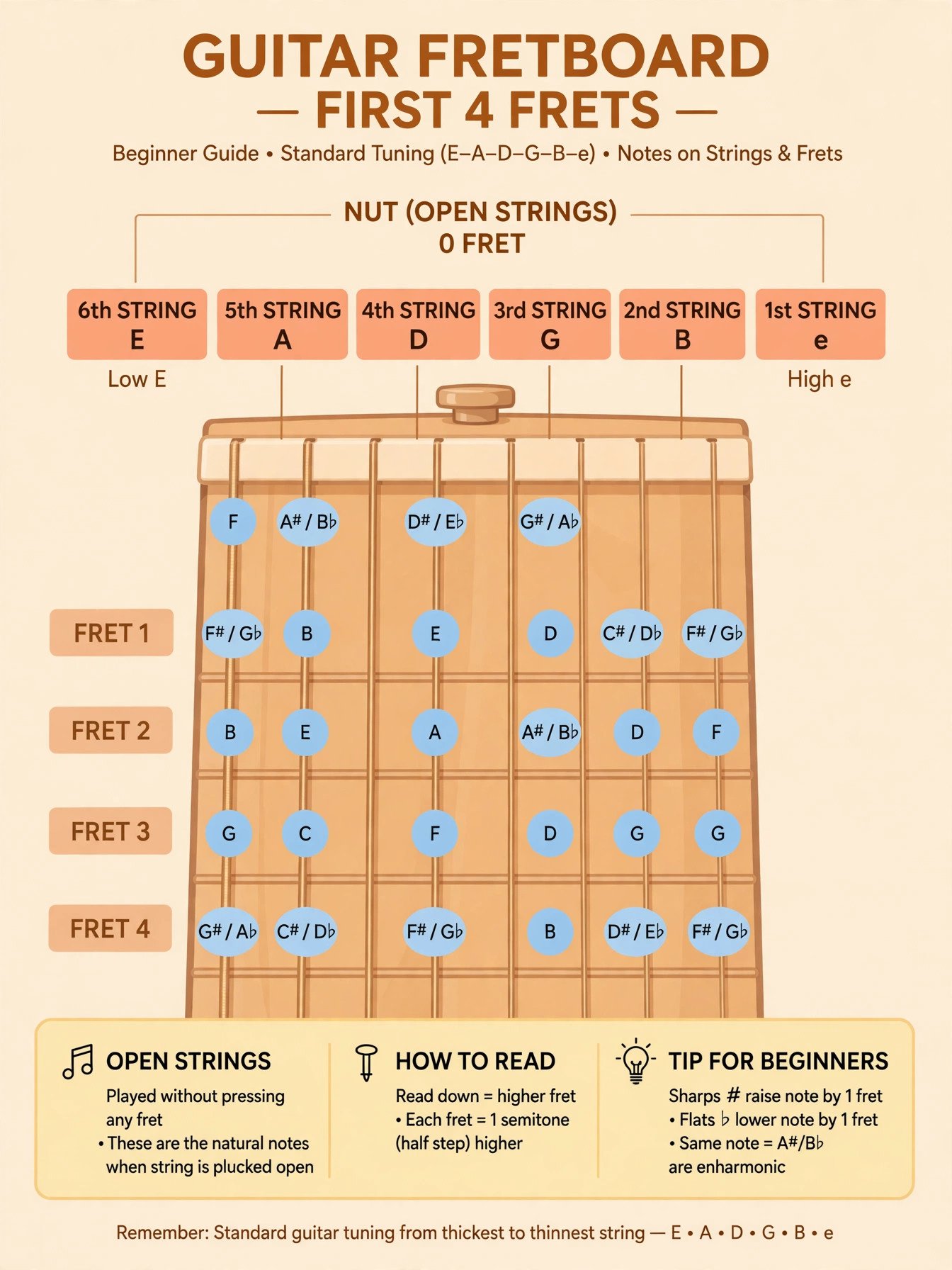
Piano and guitar note names connect letter names to physical keys and strings.
- Low E String Thickest open guitar string
- A String Fifth open guitar string
- D String Fourth open guitar string
- G String Third open guitar string
- B String Second open guitar string
- High E String Thinnest open guitar string
- Low A Key Lowest piano key note
- Piano C1 Low piano octave C
- Piano C7 High piano octave C
- Top C Key Highest piano key note
- Tuning A Standard 440 hertz note
- Guitar Low E Open low E note
- Guitar A2 Open A string note
- Guitar D3 Open D string note
- Guitar G3 Open G string note
- Guitar B3 Open B string note
- Guitar E4 Open high E note
- Violin G Lowest violin open string
- Violin D Second violin open string
- Violin A Third violin open string
- Violin E Highest violin open string
- Cello C Lowest cello open string
- Bass E Lowest bass guitar string
- Bass A Second bass guitar string
- Ukulele A Highest ukulele open string
What Are the Benefits of Learning Note Names?
Learning note names makes reading sheet music and playing instruments much easier. These benefits show why every beginner should learn them.
Read Sheet Music Faster
Named notes turn the staff into plain language. You will stop counting lines and start playing smoothly.
Learn Songs Quicker
When you know notes, tabs and tutorials make instant sense. You will pick up songs in days, not weeks.
Play With Other Musicians
Musicians talk in note names when they jam together. Knowing the names lets you join in.
How Do You Choose Which Note Names to Learn First?
Start with the seven natural letters on the piano. Learn middle C first as your main landmark.
Next add sharps and flats, then treble clef lines and spaces. Save solfege and bass clef for week two.
What Are Expert Tips for Mastering Note Names?
Say each note name out loud as you play it, because hearing it locks it in memory. Practice ten minutes a day instead of one long weekend session. Use flashcards for staff notes and quiz yourself first.
Learn notes in small groups, like only the treble lines this week. Test yourself with real songs, since naming the notes of a simple melody beats drilling charts. Teach a friend what you learned, because explaining notes proves you truly know them.
Related Name Ideas
If note names sparked your interest, our complete music note names guide goes deeper into symbols and pitch charts. Music lovers also enjoy our username ideas for artists for stage names and band handles.
Piano players can pair these names with solfege and scales for faster progress. Guitar players should link each fret name to its staff note.
Generate Your Own
Want a cool name for your music channel or band? Try our free username generator to create music style usernames in seconds.
Personal Experience
I learned notes the slow way, counting up from middle C every time. The FACE trick made the spaces click overnight.
The piano pattern helped me most, since finding C by the two black keys never fails. I still hum Do Re Mi when a melody gets tricky.
FAQs
What are note names?
Note names are the letters, syllables, and symbols musicians use to name every pitch. The seven natural note names are A, B, C, D, E, F, and G, and they repeat across every octave. Sharps, flats, and solfege syllables like Do and Re name the pitches in between.
How many pitch names are there?
There are seven natural note names, plus five sharp and five flat names, making twelve pitch names in total. Each pitch repeats in every octave with a number added, like C4 or A3. Note value names like whole note and quarter note name rhythm symbols too.
What is the easiest way to learn notes?
The easiest way to learn notes is to start on the piano and memorize the seven white key letters first. Find C by the group of two black keys, then name the keys moving up. Add one sharp or flat per day, and quiz yourself on staff notes for ten minutes daily.
Which notes sit on the treble clef?
The treble clef line notes from bottom to top are E, G, B, D, and F, remembered by the phrase Every Good Boy Does Fine. The space note names are F, A, C, and E, which spell the word FACE. The curl of the treble clef marks the G line as a landmark.
Which notes sit on the bass clef?
The bass clef line notes from bottom to top are G, B, D, F, and A, remembered by Good Boys Do Fine Always. The space note names are A, C, E, and G, remembered by All Cows Eat Grass. The two dots of the bass clef mark the F line.
What are solfege syllables?
Solfege note names are the singing syllables Do, Re, Mi, Fa, Sol, La, and Ti used to name scale degrees. Singers use them for ear training and sight singing because each syllable has a distinct sound. The Indian sargam system uses Sa, Re, Ga, Ma, Pa, Dha, and Ni the same way.
What is the difference between sharps and flats?
Sharp note names raise a natural note by a half step, like C sharp, while flat note names lower it by a half step, like D flat. Some pitches have two names, called enharmonic equivalents, such as C sharp and D flat sounding the same key. The key signature tells you which name to use.
What are the guitar string names?
Guitar string note names from thickest to thinnest are E, A, D, G, B, and E. Each fret raises the string by one half step, so the first fret of the low E string is F. The twelfth fret repeats the open string name one octave higher.
What does middle C mean in music?
Middle C is the C note near the center of the piano keyboard, named C4 in scientific pitch notation. It sits on a ledger line between the treble and bass staves and connects both clefs. Beginners use middle C as the main landmark for finding every other note.
Why do note letters repeat every octave?
Note names repeat every octave because pitches an octave apart share the same sound quality and blend perfectly. The musical alphabet restarts at A after G, so each octave holds the same seven letters. Octave numbers like C3 and C5 tell you exactly which repetition you mean.
Conclusion
These 200 entries cover every naming system a beginner needs, from piano keys to staff symbols. You now have a complete music reference to return to anytime.
Start with the seven letters and middle C, then add sharps, flats, and clef names step by step. Mastering note names turns confusing sheet music into a language you can read and play with confidence.